
A loud bang
A snapping torsion spring releases a lot of stored tension at once. Most homeowners hear it from inside the house.
Broken spring help
A garage door spring does the heavy lifting every time the door moves. When one breaks, the door suddenly weighs what it really weighs, and the opener cannot safely make up the difference. Leave the door where it is and call us here in New Prague.
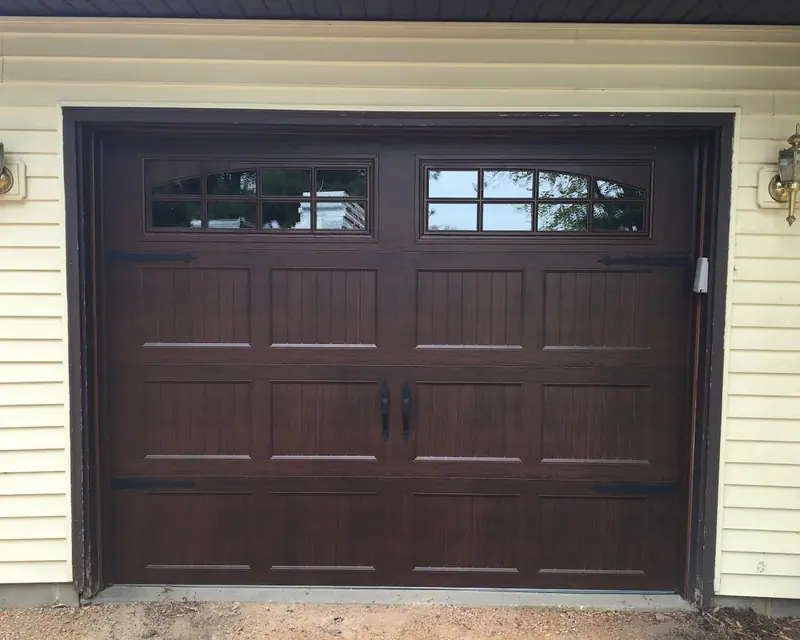
Is the spring broken?
You do not need to diagnose it yourself. If any of these sound familiar, describe them on the phone and we will know what to bring.
A snapping torsion spring releases a lot of stored tension at once. Most homeowners hear it from inside the house.
The opener hums, strains, or raises the door a few inches and gives up. Lifted by hand, the door feels far heavier than normal.
Look at the spring on the shaft above the door. A failed torsion spring usually shows a clean gap of an inch or two between the coils.
If one side lifts faster than the other, or a lift cable hangs loose, a spring or cable has likely let go on that side.
Why springs break
Garage door springs are rated in cycles. One cycle is one open and one close, and a standard spring is built for roughly 10,000 of them. A door that moves four times a day works through that in seven to ten years, so the math catches up with every door eventually.
Cold weather speeds it up. Steel loses flexibility in the cold, and a long freeze adds stress to coils that were already worn. That is why so many springs in our area let go on the coldest mornings of the year.
Mounted on the shaft above the door, torsion springs twist to lift the weight. Most doors around here run one or two of them.
Extension springs stretch along the horizontal tracks, usually on older doors and low-headroom garages, and should always run with safety cables.
A word on DIY
Torsion springs are installed under load and only come off safely with winding bars and a practiced hand. When a wound spring slips, it releases all of that energy at once, and the injuries are serious. Replacing a spring is quick work for us and genuinely risky work for anyone doing it for the first time.
What you can do: keep people, pets, and vehicles clear, leave the door in place, and skip the urge to run the opener again to test it. Every attempt strains the motor against the full weight of the door.
What to expect
Tell us your town, whether the door is stuck open or closed, and what you heard or see.
A snapped spring often strains cables, rollers, and the opener, so we look at all of it before we wind new springs.
We match the new springs to the weight of the door, test the balance by hand, and run the opener before we leave. A typical replacement is finished in a single visit.
Where we work
We are based in New Prague and replace springs in the towns around us.
That includes Belle Plaine, Jordan, Lonsdale, Montgomery, Prior Lake, Shakopee, Northfield, Savage, and Lakeville. Not sure whether your address is on our route? See all service areas or just call and ask.
Frequently asked
The things New Prague area homeowners ask us most about springs. Not seeing yours? Call (952) 465-9409 and someone here in New Prague will help.
Usually a single loud bang from the garage, often compared to a firecracker or something heavy falling. That is the spring releasing its stored tension the moment it snaps. Afterward the door feels extremely heavy and the opener may refuse to lift it.
We recommend not trying. The spring carries most of the weight of the door, often 150 pounds or more. Running the opener strains the motor against all of that weight, and lifting by hand risks the door coming down hard. Leave it where it is and call.
Yes, both. Torsion springs mount on the shaft above the door and twist to lift it. Extension springs stretch along the horizontal tracks, usually on older doors and low-headroom garages. We replace either type and balance the door afterward.
On a door with two springs, usually yes. Both springs have the same cycles on them, so when one breaks the other is close behind. Replacing the pair in one visit costs less than a second service call a month later, but we will talk it through with you first.
A standard spring is rated for about 10,000 cycles, and one cycle is one open and one close. For a door used four times a day, that works out to roughly seven to ten years. Busier doors get there sooner, and higher-cycle springs are available for doors that work hard.
Cold steel is more brittle, and a Minnesota cold snap adds stress to coils that were already near the end of their life. Winter is the busy season for spring calls around here, so it is not just your door.
Weekdays from 6 AM to 9 PM, Saturdays from 6 AM to 1 PM, and Sundays from 7 AM to noon. Call (952) 465-9409 and tell us what the door is doing.
Ready when you are
Call (952) 465-9409 or send a service request. Tell us your town and whether the door is stuck open or closed, and we will take it from there.